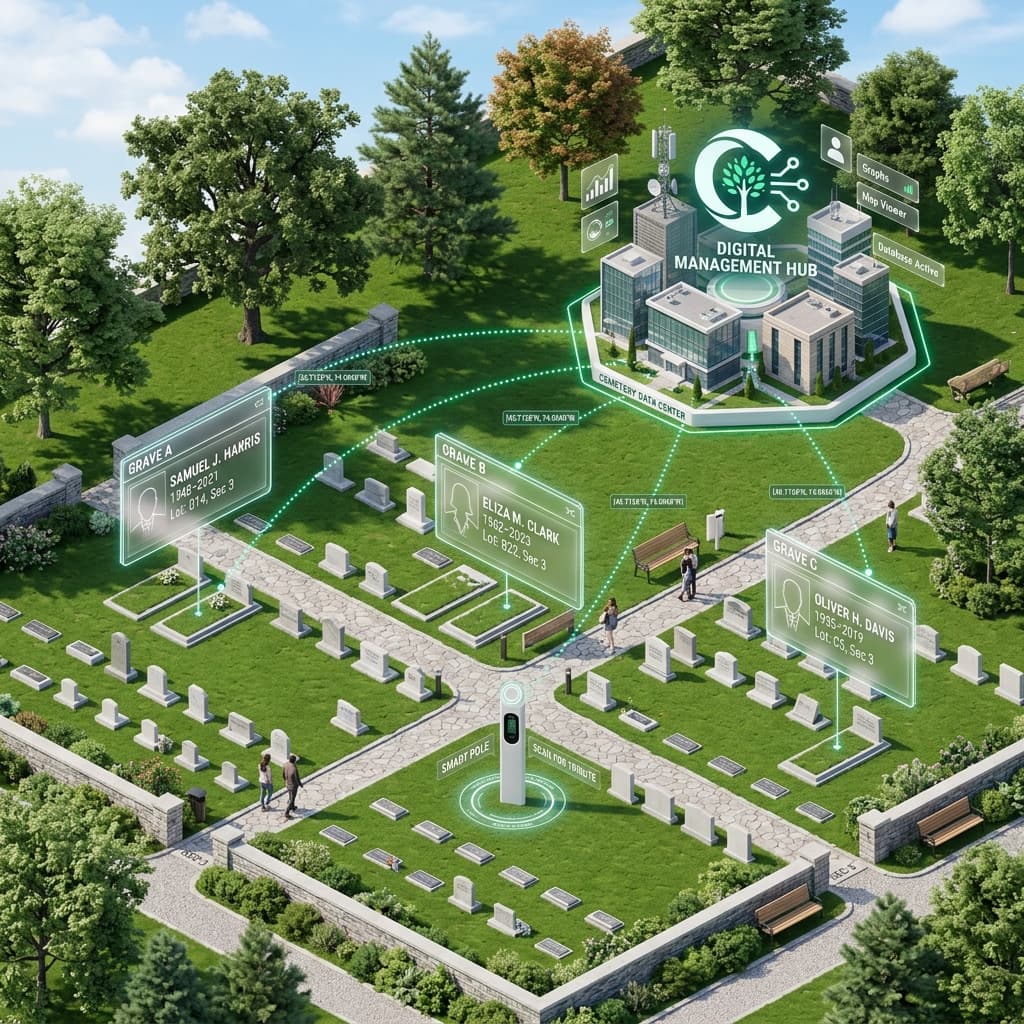
Honoring
Legacies through
Digital Mapping.
Seamlessly digitizing cemetery records and providing interactive mapping for a sacred, intuitive experience. Bringing the past into the future.
Operational in Four Steps
From paper register to permanent digital infrastructure — without disrupting day-to-day operations.
Register Burial
Cemetery staff digitally register each burial with full structured data — name, date, section, and supporting documents.
Install Smart Pole
A durable identification pole with a unique QR/NFC identity is embedded at the grave — creating a permanent physical anchor.
Link & Map
The burial record is geo-tagged to its exact location on the cemetery's centimeter-accurate digital map.
Scan or Search
Any family member or administrator locates graves instantly — by name, date, section, or by scanning the pole directly.
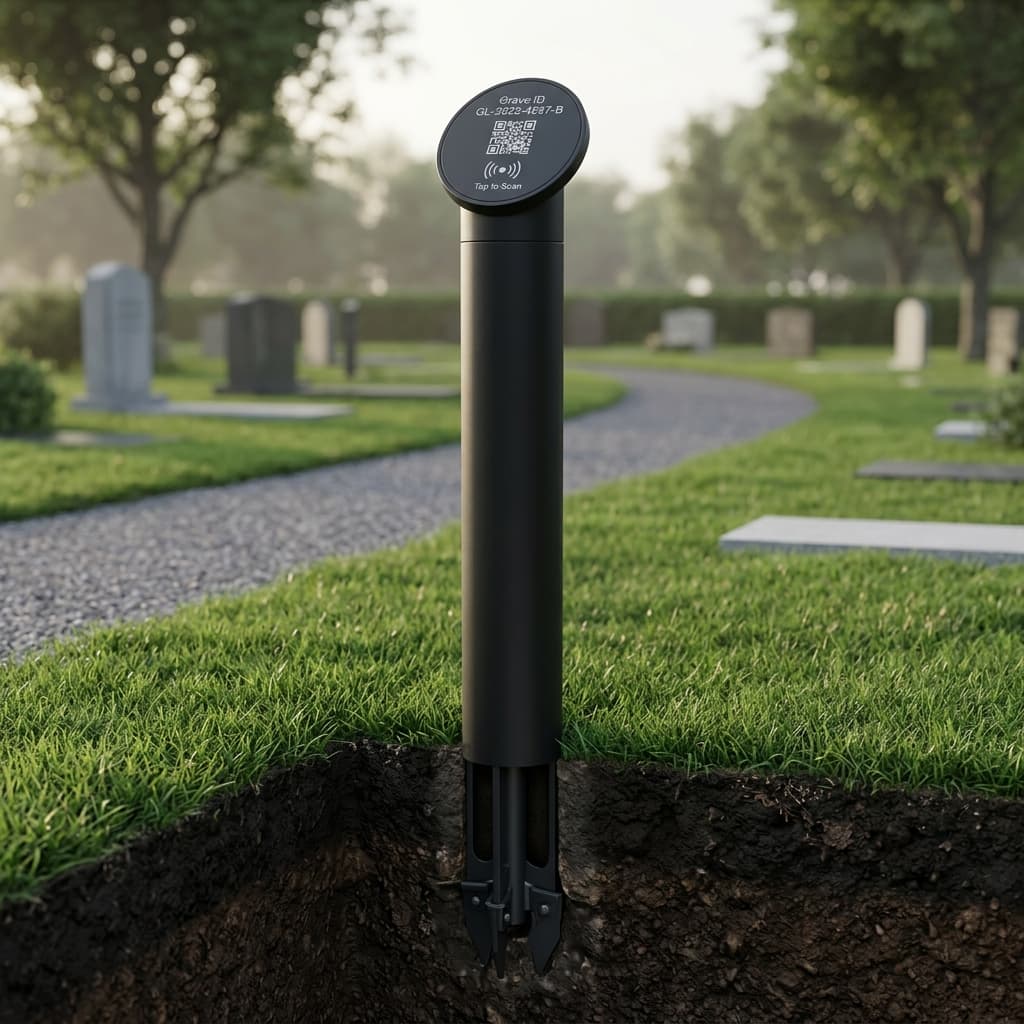
The Physical Identity Every Grave Deserves
Every grave is fitted with a durable identification pole embedded with a unique QR/NFC code. This creates an unbreakable physical-to-digital link that survives decades — the missing piece in every burial system today.
Permanent Ground Identity
Anti-theft, weather-resistant pole anchored to the burial site — this is the physical ledger entry.
Instant Digital Access
QR and NFC embedded for zero-friction record retrieval from any device, any time.
Error Elimination
Removes the manual register chain entirely — no duplicate records, no location drift.
Universal Fit
Adapts to Islamic, Christian, municipal, and private cemetery structures.
Burial infrastructure is broken and invisible.
Across governments, religious institutions, and private cemeteries — the systems for recording who is buried, where, and in what condition are failing silently. Families are losing legacies. Administrators are losing accountability.
to locate older burial records
Most cemeteries rely on handwritten registers and staff memory to find graves, making retrieval slow and inconsistent.
record systems with no backup
Registers are often torn, water-damaged, or incomplete, with no digital copies — leading to permanent data loss.
grave reuse without history tracking
In urban cemeteries, graves are reused over time, but previous burials are rarely recorded or preserved.
grave identification system
Each cemetery uses its own method — no unified IDs, no interoperability, and no way to verify records across systems.
GraveLedger replaces the fragile paper-and-memory system with a structured, mapped, and permanently verifiable burial infrastructure that stands the test of time.
Built for Real-World Operations
Cemetery Mapping
Section and block-based grave organization with precise geo-tagged visualization — every burial has a coordinate.
Digital Burial Records
Structured, searchable registry with unique burial IDs, document attachments, and full history.
QR / NFC Access
Scan any grave pole to instantly retrieve its record — no app, no staff dependency, no manual search.
Admin Dashboard
Burial tracking, section occupancy, reporting, and data export — operational clarity for administrators.
Pole Lifecycle Management
Track pole assignment, installation status, and replacement history with full audit trail.
Multi-Site Control
Manage multiple cemeteries from a single centralized headquarters dashboard — built for scale.
Built for Three Stakeholders
GraveLedger serves every party that touches a burial — from operations to oversight to family access.
Cemetery Trusts & Operators
Replace error-prone paper processes with a digital-first burial management workflow. Track every grave, every pole, every record — with accountability built in.
Municipal Corporations
Centralized burial database across all cemeteries in your jurisdiction. Generate regulatory reports instantly. Prove accountability to governing bodies.
Families
No more staff dependency, no manual directory searching. Scan a pole or type a name — and navigate directly to the grave with real-time precision.
Locate a Grave in Under 10 Seconds
No staff required. No manual directory. No wrong turns. Just scan, search, and navigate.
Enter name or scan pole
View structured record
See exact grave location
Navigate within cemetery
Security that Institutions Can Stand Behind
GraveLedger is architected for accountability. Every layer of the system is designed around one question: "Who did what, when, and can we prove it?"
Role-Based Access Control
Granular permissions — staff can enter records, only admins can delete. Every action is tied to an identity.
Complete Audit Trail
Every change to every record is timestamped and attributed. No modification goes unlogged.
Controlled Public Visibility
Only the fields you choose are publicly visible. Sensitive family data remains gated.
Municipal Compliance
Reporting and data export formats meet the rigorous standards of institutional and municipal bodies.
Encrypted Data at Rest
All burial records are stored with encryption. Data sovereignty for every organization.
Verification-Ready
Records can be exported, hashed, and verified — providing irrefutable proof of burial history.
Scalable infrastructure.
Clear costs.
From individual family plots to national municipal networks, GraveLedger scales seamlessly.
Starter Plan
Quick onboarding for small cemeteries and pilot deployments.
Trust Plan
Complete digital infrastructure for independent cemeteries and local trusts.
Enterprise
Full-scale governance and smart city integration for municipalities and states.
Common Questions
Answers to what cemetery operators, municipalities, and families ask most often.
Contact us for moreCan graves be pre-booked?
No. GraveLedger is designed for post-burial record management and identification, not plot ownership or reservations. The system activates when a burial is registered.